AI Automation: Transforming the Future of Business Efficiency
Artificial Intelligence (AI) Automation is rapidly changing the way businesses operate across every industry.

Artificial Intelligence (AI) Automation is rapidly changing the way businesses operate across every industry. From customer support and marketing to sales and operations, AI-powered automation helps organizations complete repetitive tasks faster, reduce costs, and improve overall productivity. As technology continues to evolve, businesses of all sizes are adopting AI automation to stay competitive and deliver better customer experiences.
Whether you run a startup, an agency, an eCommerce store, or a large enterprise, AI automation can streamline your workflows and allow your team to focus on high-value tasks instead of manual processes.
What Is AI Automation?
AI automation combines artificial intelligence with automation technology to perform tasks that normally require human intelligence. Unlike traditional automation, which follows fixed rules, AI automation can analyze data, recognize patterns, make predictions, and continuously improve its performance through machine learning.
Examples of AI automation include:
AI chatbots for customer support
Email marketing automation
Lead qualification
Appointment scheduling
Invoice processing
Social media content generation
Data analysis and reporting
Workflow automation across multiple platforms
These intelligent systems work around the clock, ensuring faster and more accurate execution of business processes.
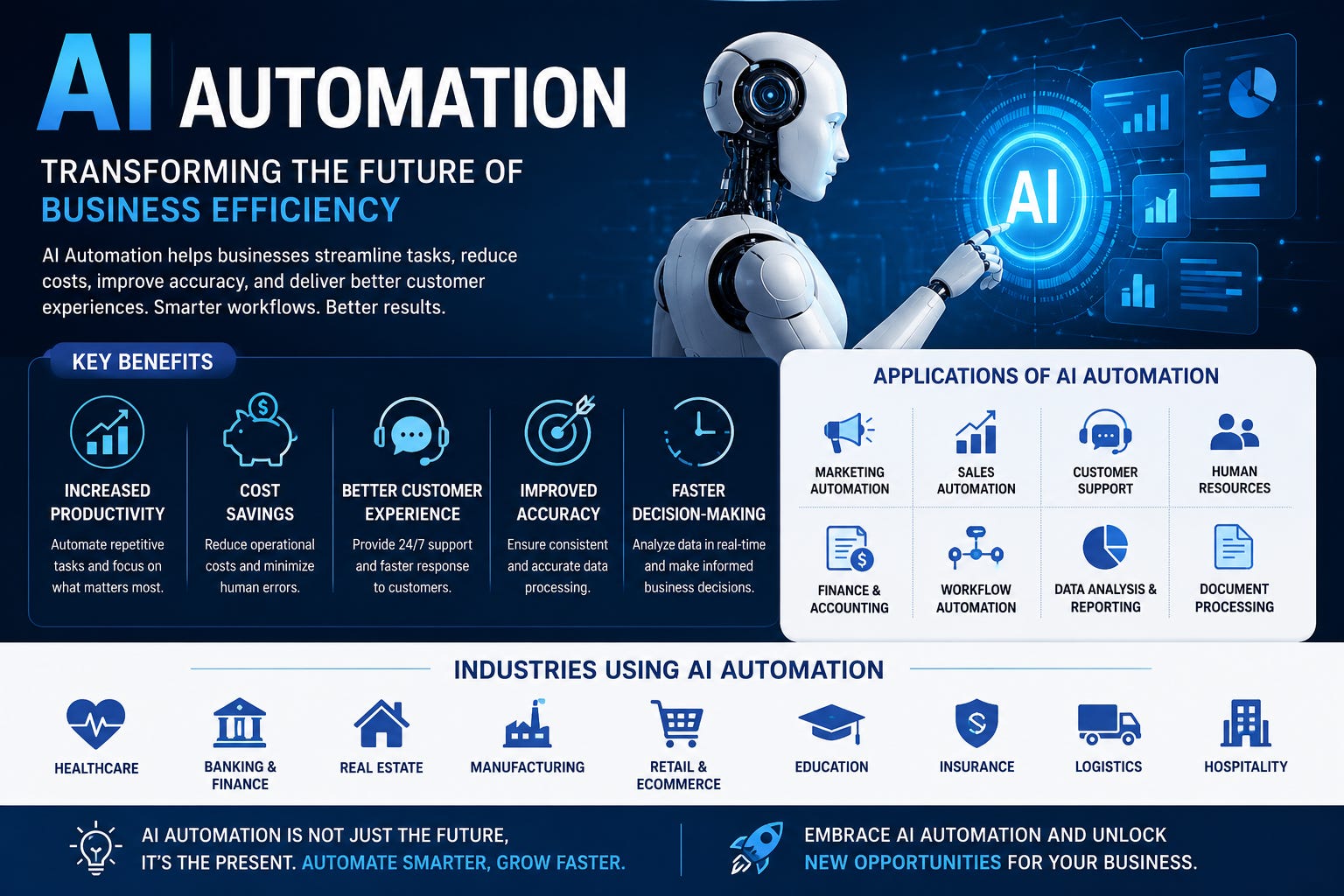
Benefits of AI Automation
Increased Productivity
One of the biggest advantages of AI automation is improved productivity. Employees spend less time performing repetitive administrative work and more time focusing on strategic activities such as business development, innovation, and customer relationships.
Cost Savings
Automating routine tasks reduces labor costs while minimizing human errors. Businesses can operate more efficiently without constantly increasing staffing expenses.
Better Customer Experience
AI-powered chatbots and virtual assistants provide instant responses to customer inquiries, improving satisfaction and reducing response times. Customers receive support 24/7 without waiting for business hours.
Improved Accuracy
Manual data entry often leads to mistakes. AI automation significantly reduces errors by processing information consistently and accurately.
Faster Decision-Making
AI systems analyze large amounts of data within seconds. Business leaders receive valuable insights that help them make informed decisions based on real-time information.
Applications of AI Automation
Marketing Automation
Marketing teams use AI to automate email campaigns, customer segmentation, social media scheduling, content recommendations, and personalized marketing messages. AI helps businesses target the right audience with the right content at the right time.
Sales Automation
Sales professionals benefit from AI automation by automatically capturing leads, scoring prospects, scheduling follow-ups, generating proposals, and updating customer relationship management (CRM) systems.
Customer Support
AI chatbots can answer frequently asked questions, guide customers through purchasing decisions, resolve common issues, and escalate complex cases to human representatives when necessary.
Human Resources
HR departments use AI automation for resume screening, interview scheduling, employee onboarding, payroll assistance, and performance tracking, making recruitment and employee management more efficient.
Finance and Accounting
AI can automate invoice processing, expense tracking, fraud detection, financial reporting, and payment reminders while improving compliance and reducing accounting errors.
Industries Using AI Automation
AI automation is becoming essential across numerous industries, including:
Healthcare
Banking and Finance
Real Estate
Manufacturing
Retail and eCommerce
Digital Marketing Agencies
Education
Insurance
Logistics
Hospitality
Each industry uses AI differently, but the primary objective remains the same: improve efficiency while reducing operational costs.
AI Automation for Small Businesses
Small businesses often have limited resources, making automation especially valuable. AI tools help entrepreneurs manage customer inquiries, generate marketing content, automate appointment bookings, track inventory, and nurture leads without hiring additional staff.
Cloud-based AI solutions have made advanced automation affordable even for startups, allowing small businesses to compete with larger organizations.
Popular AI Automation Tools
Many businesses integrate AI automation using modern software platforms. Popular categories include:
CRM automation
Workflow automation platforms
AI writing assistants
Customer service chatbots
Marketing automation software
AI scheduling assistants
Document processing tools
Predictive analytics platforms
The right solution depends on business size, goals, and existing technology stack.
Challenges of AI Automation
Although AI automation offers many advantages, businesses should also consider potential challenges.
Initial Setup
Implementing AI systems requires planning, integration, and configuration. Businesses should clearly define their objectives before deployment.
Data Quality
AI performs best when trained using accurate and organized data. Poor-quality data can reduce automation effectiveness.
Employee Training
Employees need proper training to understand how AI tools work and how to collaborate with automated systems effectively.
Security and Privacy
Organizations must ensure customer data remains secure and comply with relevant privacy regulations when implementing AI-powered solutions.
The Future of AI Automation
The future of AI automation looks incredibly promising. As machine learning models become more advanced, businesses will automate increasingly complex processes with greater intelligence and accuracy.
Future developments may include:
Smarter virtual assistants
Fully autonomous business workflows
Predictive customer support
AI-powered strategic planning
Advanced voice automation
Hyper-personalized customer experiences
Intelligent document management
Companies that embrace AI automation today will be better positioned to adapt to future technological advancements and changing customer expectations.
Conclusion
AI automation is no longer a luxury reserved for large corporations. It has become a practical and valuable solution for businesses looking to improve efficiency, reduce operational costs, and enhance customer satisfaction. From automating repetitive administrative tasks to providing intelligent business insights, AI automation empowers organizations to work smarter rather than harder.
As AI technology continues to evolve, businesses that invest in automation will gain a competitive advantage through faster operations, improved decision-making, and better customer experiences. By implementing the right AI automation strategy, organizations can unlock new opportunities for growth while preparing for the future of digital transformation
.